
TV Mounting on Stone and Tile Feature Walls in Newport Beach
TV Mounting Atelier Newport Beach covers TV mounting on the stone, tile and porcelain slab feature walls that Newport Beach homes are known for — the wall that is the centerpiece of the room and that nobody wants cracked — where a local installer plans every hole before the first one is drilled.
Bookings aren't open yet. Leave your name and number; your message is recorded, and you'll get one message when a local installer is available.
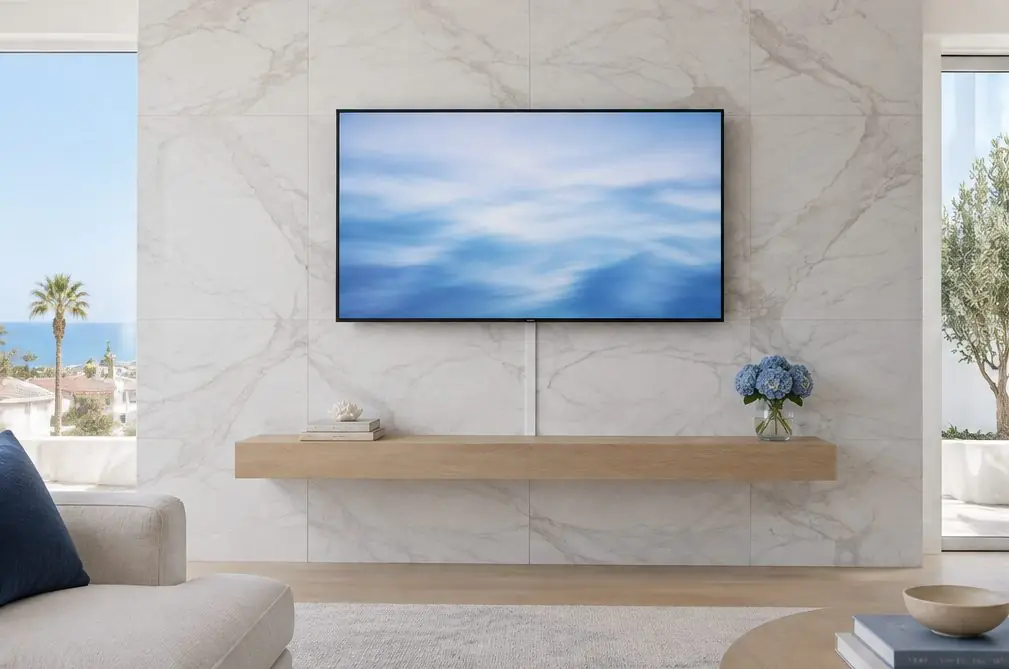 Illustration
Stone, mortar joints and sleeve anchors
| Wall finish | What it is | What holds the mount |
|---|---|---|
| Stacked or ledger stone | Stone pieces on a mortar bed over framing | Sleeve anchors in the stone body, or screws through the veneer into framing |
| Solid stone or brick | Full-depth masonry | Sleeve anchors set in the stone or brick |
| Concrete block | Hollow or filled block | Sleeve anchors for filled block, toggles rated for hollow block |
| Stone veneer with no framing behind | Thin cladding on a lath coat | Not suitable for a mount alone |
The installer probes first to learn whether the wall is solid or veneer, because the right hardware depends on what is behind the face.
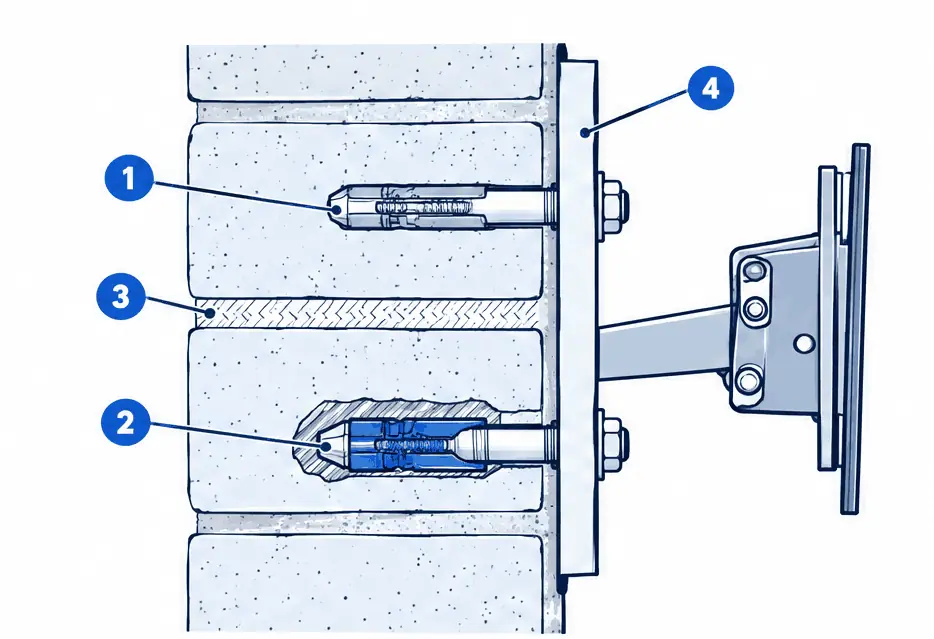
What the numbers show
- Hole in the brick body The hole is drilled in the body of the brick or stone, away from the joints.
- Expanding sleeve As the bolt is tightened, a cone expands the sleeve and grips the masonry.
- Mortar joint The joint between the bricks is too soft to hold an anchor under load.
- Wall plate The plate is clamped flat against the face of the brick by the anchors.
Tile and porcelain slab walls
Large-format porcelain and natural-stone tile is hard and brittle. A diamond core bit cuts a clean hole and lowers the risk of chipping the edge, and the holes are placed away from tile edges and grout intersections where the surface is weakest. Behind the tile, a fastener should land in a stud or in solid backing; tile is a surface, not a support.
- Layout first: painter's tape and a level mark the plate; a template shows where the holes meet the tile joints.
- Water for the bit: the diamond bit is cooled while it cuts, which keeps dust down and the edge crisp.
- Snug, not crushed: the plate is tightened until it sits flat, no further, so the tile is not stressed.
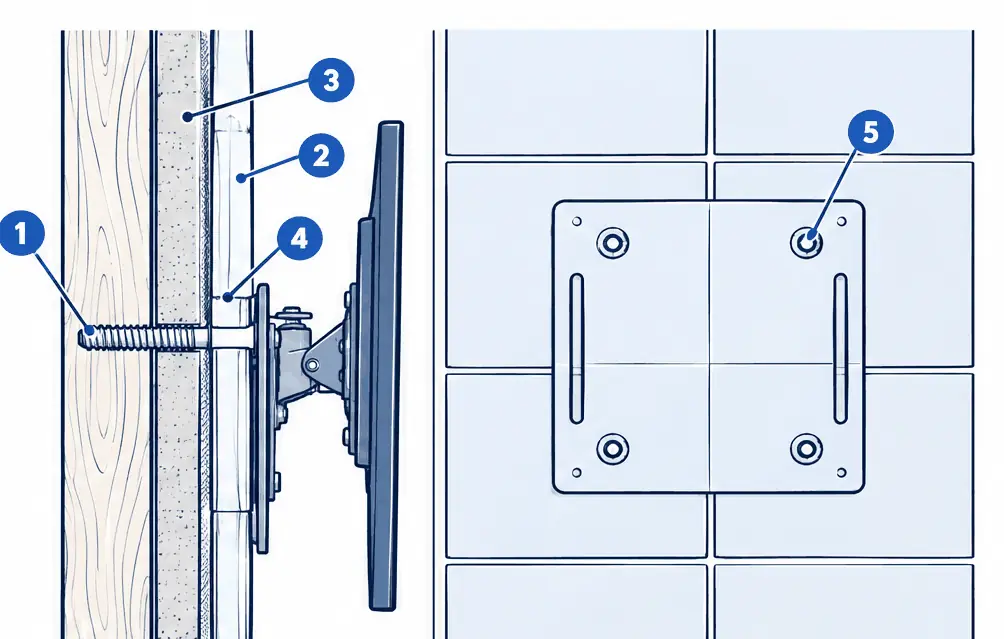
What the numbers show
- Lag bolt into the stud The bolt passes through the plate, the tile and the backer board and threads into the middle of the stud, so the framing carries the weight.
- Porcelain tile The tile is hard but brittle; it is a finish and does not carry load.
- Cement backer board The board the tile is set on is drilled through with the same hole, and the stud behind it is the solid fixing point.
- Cored hole A diamond core bit cuts a clean, slightly oversized hole without chipping the edge.
- Holes between the joints In the front view the plate holes sit away from grout intersections and tile edges, where the surface is weakest.
Wires on a finished wall
Stone and slab cannot be opened for cables. The usual options are a paintable raceway, a run in the neighboring drywall section to a cabinet, or a floating shelf that hides the cable and the box behind it.
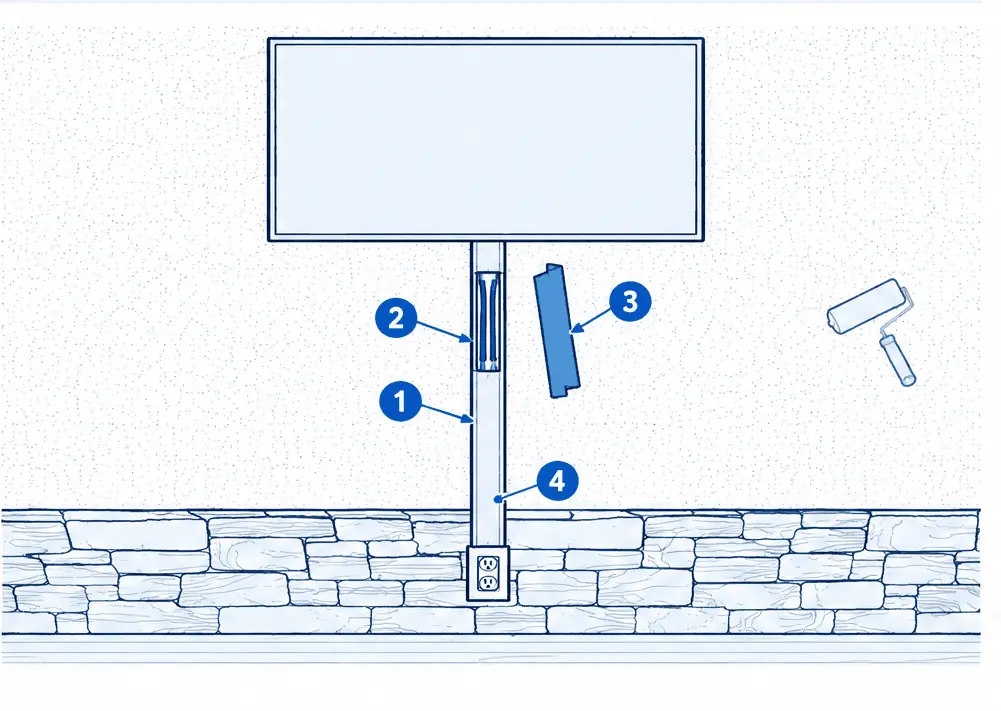
What the numbers show
- Raceway channel A slim two-part channel is fixed to the wall; the cables lie in its base and the cover snaps on.
- Cables inside Signal cables and the TV's own power cord run inside to an existing outlet; no new wiring is added in the wall.
- Paint to match The cover takes paint, so it reads as part of the wall.
- Straight run A straight vertical run from the centre of the TV to the outlet looks deliberate and is easy to remove later.
Stone & Tile Feature Wall TV Mounting — common questions
How much more does a tile or stone wall cost?
Stone, brick or block adds about $65–$110 to the base range in 2026; a tile or porcelain slab wall adds about $80–$140.
Can a TV go on a stone wall with no studs behind it?
Yes, if the stone is solid enough to hold sleeve anchors in the stone body. A thin veneer over lath is probed first and may need another position.
Availability & price range
Stone & Tile Feature Wall TV Mounting: check availability and price range
Bookings aren't open yet — answer a few quick questions about the TV and the wall and get a typical Newport Beach price range right here. Typical Newport Beach prices for one TV, labor only unless an option says otherwise. This is a market estimate, not a quote.