
TV Wall Mounting in Newport Beach
TV Mounting Atelier Newport Beach handles the most common TV mounting request in Newport Beach — a single screen on a drywall wall over wood framing, whether it is a family room in Eastbluff, a den in Newport Heights or a guest bedroom in a Westcliff remodel — with a fixed or tilting bracket bolted into the studs, a height worked out from the actual seats and the cords kept short and neat.
Bookings aren't open yet. Leave your name and number; your message is recorded, and you'll get one message when a local installer is available.
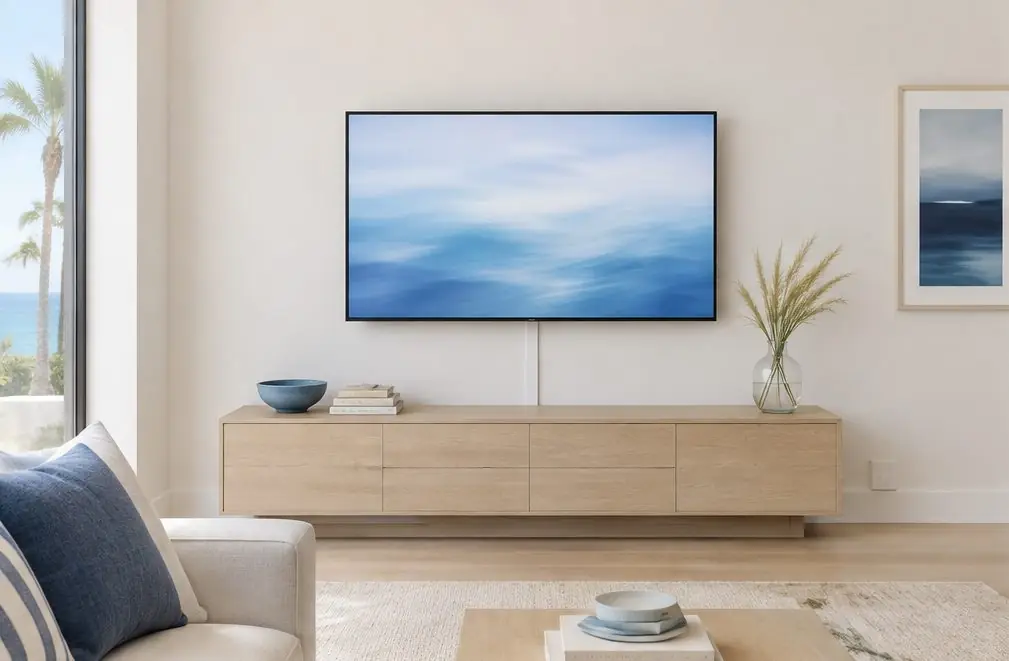 Illustration
TV Wall Mounting in Newport Beach, CA typically runs $129–$539 per TV in our 2027 estimator, depending on the TV size and the wall type. Use the estimator below for your own numbers.
Finding wood behind the wallboard
Most single-family houses in town, from the 1960s and 1970s tracts above the Back Bay to the newer rebuilds, are framed in wood with studs roughly 16 inches apart. Remodels complicate that picture: a widened opening, a moved doorway or a new pocket door can leave the framing somewhere other than where the pattern predicts.
| What the finder reports | Likely explanation | What happens next |
|---|---|---|
| Even marks every 16 in | Original framing, untouched | Plate laid over two marks, one probe hole to confirm |
| Wide solid zone | Header over a door or window, or doubled studs | Good bearing; the plate can often go anywhere across it |
| Nothing for 2–3 ft | A remodel moved or removed a stud | Wider plate, a sliding bracket or a different position |
| Metal under the sensor | Nail plate protecting a pipe or wire | No drilling at that spot |
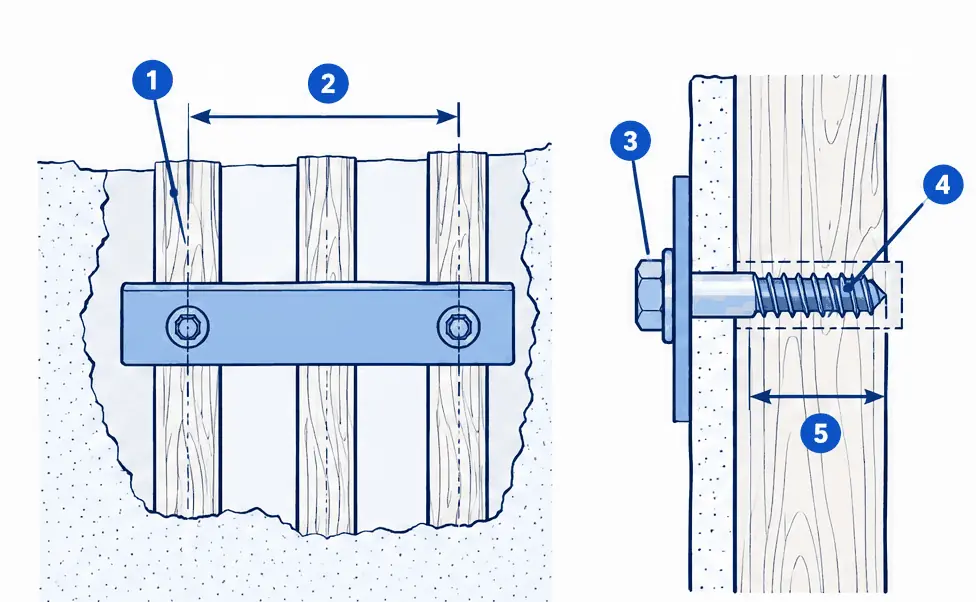
What the numbers show
- Center of the stud Each bolt is aimed at the stud center line, located with a finder and confirmed with a small probe hole.
- Spacing Wood studs typically stand about 16 inches apart on center, which is why a wide plate catches two.
- Head and washer The washer under the hex head spreads the pressure across the face of the plate.
- Thread grip The threaded part bites solid wood in the middle of the stud and stops inside it.
- Embedment The threads sit in wood, well past the layer of gypsum in front of the stud.
When the best spot lands on a hollow bay
The wall the room is built around does not always have a stud where the screen should be centered. Before giving up on the position, there are a few honest ways to keep it:
- A plate wide enough to reach two studs, with the TV brackets slid sideways on the rails until the screen is centered on the seats.
- Strap toggles at the open end of a plate that is already bolted into at least one stud, adding grip without asking the drywall to carry the set alone.
- A backer board fastened across several studs and painted, for a large screen in a spot with no usable framing.
- Moving the screen a few inches, which is often invisible from the sofa and simpler than any hardware.
Fixed or tilting, chosen by the room
The bracket type follows the seating and the light rather than habit.
- Fixed suits a screen at seated eye height on a wall with no window across from it; it sits closest to the wall and has the fewest moving parts.
- Tilting suits a screen that has to sit higher, over a console or a credenza, or a room where afternoon light from the Back Bay or the harbor side lands on the glass.
- Neither suits a corner or an open kitchen; that is a job for a full-motion arm.
Deep, low lounge sofas, common in coastal furnishing, put the eyes lower than a dining chair does, and the screen center is measured from that seat, not from a rule printed on the box.
Leaving a custom-painted wall as it was
Many rooms here are finished in mixed custom colors with a smooth or lightly textured surface, and a careless hole shows. Drill points are marked on low-tack tape, a vacuum nozzle is held under the bit, and any test holes are placed inside the outline of the plate so the mount covers them afterward.
TV Wall Mounting — common questions
What does one TV on drywall cost in Newport Beach in 2027?
Typical labor runs about $129–$179 for a 32–49 inch set and $159–$219 for 50–65 inches when the wall is drywall over wood studs. Bigger screens move into higher bands, and stone, tile, steel studs or a fireplace add to the base.
Can the installer supply the mount, or should it be bought first?
Both are common. A supplied mount adds $55–$165 depending on type and size; a bracket that is already in the box is checked against the TV's weight and VESA pattern before it goes up.
Can a large TV go on plain drywall with no stud behind it?
Not on drywall alone. The plate needs at least one stud, a wide plate reaching two, or a backer board across several; strap toggles only add grip to a plate that is already anchored in framing.
Availability & price range
TV Wall Mounting: check availability and price range
Bookings aren't open yet — answer a few quick questions about the TV and the wall and get a typical Newport Beach price range right here. Typical Newport Beach prices for one TV, labor only unless an option says otherwise. This is a market estimate, not a quote.